Voicemail Is Dead. Long Live Voicemail: The 18-Second Script That Gets Callbacks
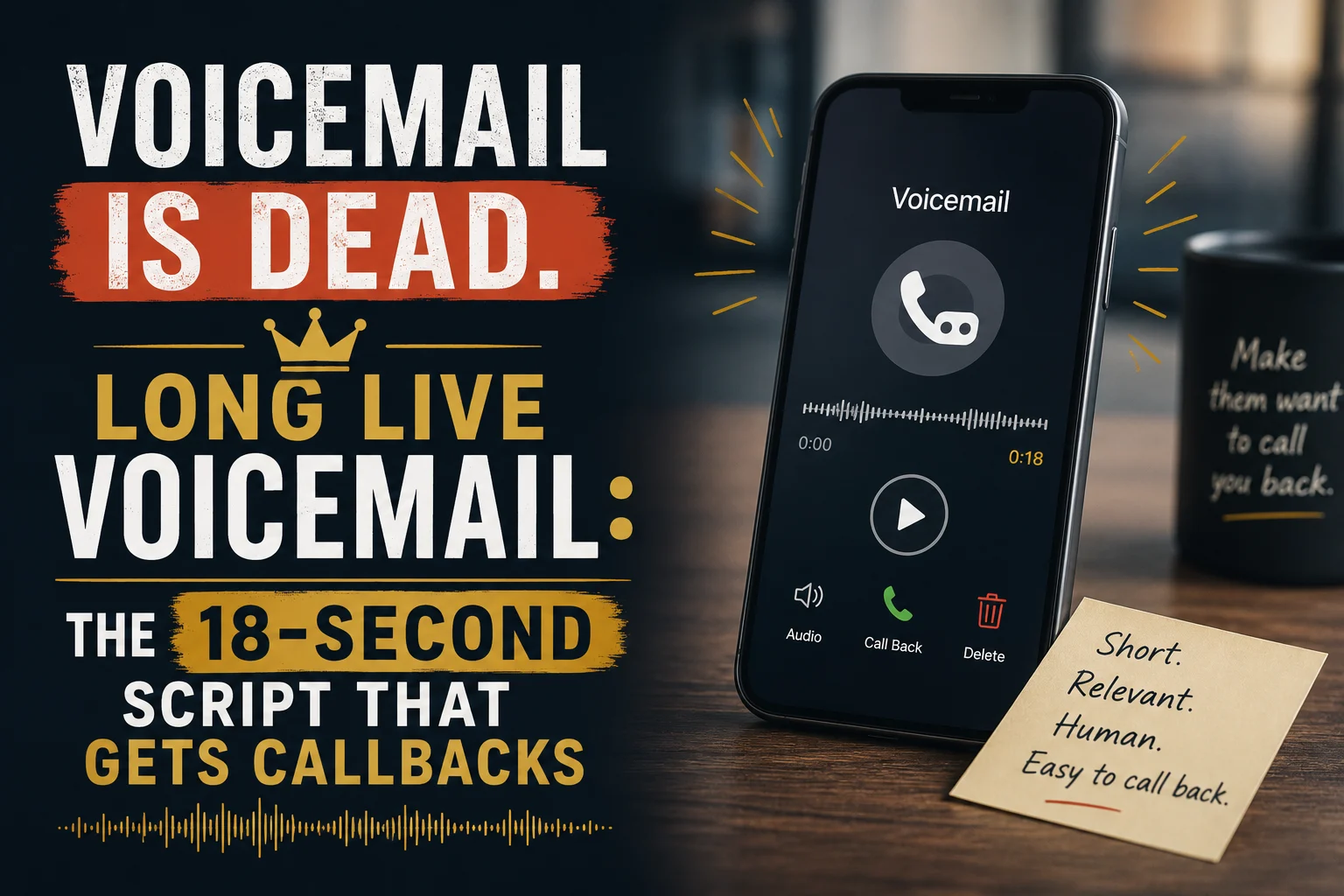
Every sales blog written in the last decade has declared voicemail dead.
The argument goes like this: nobody checks voicemail anymore. Visual voicemail transcripts are unreliable. Decision-makers route everything to assistants. Mobile screening apps block unknown numbers. The behavioral data shows callback rates somewhere between 1% and 3%, depending on the study.
So salespeople have largely stopped leaving voicemails. They call, hear the beep, hang up, and move on.
Here's the problem with that conclusion: voicemail callback rates are low because the voicemails being left are bad. Almost universally, embarrassingly bad. The salesperson rambles, pitches, asks for callbacks they're never going to get, and wastes 90 seconds of the prospect's life.
If you leave that voicemail, of course nobody calls you back. The voicemail isn't the problem. Your voicemail is the problem.
When you optimize the voicemail itself—structure, length, content, and pacing—callback rates climb significantly. Not to 50% or anything magical. But to high single digits or low double digits, which is plenty when you consider that the voicemail itself is essentially a free additional touch in your sequence.
More importantly, even unreturned voicemails do work for you. They build name recognition. They warm up subsequent emails and calls. They contribute to the "this person is serious about reaching me" signal that eventually breaks through.
Here's how to leave voicemails that actually work in 2026.
Why Most Sales Voicemails Fail
Before we get to what works, let's look at what doesn't. Here's the voicemail that 90% of salespeople leave:
"Hi Sarah, this is Mike Johnson calling from Acme Solutions. I hope you're doing well today. The reason for my call is that we're a leading provider of marketing automation software that helps companies like yours streamline their lead generation processes and improve conversion rates by up to 47%. I'd love to schedule a brief 15-minute call to learn more about your current marketing challenges and explore how we might be able to help. You can reach me at 555-123-4567. Again, that's Mike Johnson at 555-123-4567. Looking forward to connecting with you. Have a great day."
That's 73 seconds of pure waste. Let's count the problems:
It opens with a meaningless pleasantry. "I hope you're doing well today" is the verbal equivalent of "this is a sales call, please delete." Sarah's brain has already classified you and started reaching for the delete button.
It announces its sales nature in the second sentence. "The reason for my call is that we're a leading provider..." translates to "I want to sell you something." Delete button pressed.
It pitches without context. Sarah doesn't care what you do or who you help. She cares about herself and her problems, neither of which you've referenced.
It includes vendor jargon. "Marketing automation software." "Lead generation processes." "Conversion rates." Words she's heard a thousand times from a thousand vendors, all of whom blur together.
It asks for time without offering value. Why would Sarah give you 15 minutes? You've given her no reason. You've established no relevance. You've earned no interest.
It says the phone number twice but says everything else only once. Even if Sarah were inclined to call back, by the time you said your number the second time, she'd forgotten everything you said about who you are and why she should care.
It runs more than a minute. Long after Sarah hit delete.
This is the voicemail that made everyone declare voicemail dead. It deserves to die. The question is what should replace it.
The 18-Second Framework
Eighteen seconds. That's your target. Long enough to deliver real value, short enough to respect their time. Anything longer and you're losing them. Anything shorter and you can't fit the necessary elements.
Here's what fits in 18 seconds:
Seconds 0-3: Name and company, said clearly and at normal speed. "Hi Sarah, this is Mike Johnson from Acme."
Seconds 3-9: Specific reason for the call, focused on them. "I'm calling because I saw your team just expanded into the European market."
Seconds 9-15: The hook—why they'd want to talk to you. "We've helped three other SaaS companies handle EU data compliance during expansion without slowing down their launch."
Seconds 15-18: Soft close with permission, no callback request. "I'll send you a quick email with details—no need to call back."
Total: 18 seconds. Done.
Notice what's missing: no asking for callbacks, no phone number, no pleasantries, no pitch. Just specific relevance and a low-pressure handoff to email.
Why no callback request? Because they won't call you back. They almost never do, regardless of how compelling your message is. Asking for a callback you're not going to get is wasted breath. Worse, it triggers the resistance response—the moment you ask for something, defensive walls go up.
Instead, you're using the voicemail to do three things: establish that you exist, demonstrate that you've done your homework, and warm up the email that's coming next.
The Hook Library
The middle of your voicemail—the hook—is what determines whether the next email gets opened or deleted. Generic hooks fail. Specific, relevant hooks work.
Build a library of hooks for different situations. Here are categories that consistently work:
The trigger event hook. "I'm calling because I saw [specific recent event]—your acquisition of [company], your move into [market], your hire of [person], your announcement about [initiative]."
This signals research and relevance immediately. You're not calling because they're on a list. You're calling because something specific is happening in their world that you understand.
The peer reference hook. "I work with [similar company they'd recognize] on [specific outcome]. Wanted to reach out because you're facing some of the same situations they were."
Be careful here—the peer reference must be genuinely similar (similar size, similar industry, similar situation), and you must actually work with them. Faking peer references is a fast way to destroy credibility when discovered.
The insight hook. "I have some data about [their industry] that I think would surprise you. Specifically, [one-sentence intriguing data point]."
This works when you genuinely have insight worth sharing. Don't fake it. If you don't have the data, don't use this hook.
The problem-specific hook. "I'm calling about [specific problem their type of company typically faces], particularly around [specific dimension of that problem]."
This works when you have specific knowledge of their industry's pain points. The specificity is critical—"marketing challenges" doesn't work, "the conversion drop-off you're probably seeing in middle-of-funnel content" does.
The mutual connection hook. "[Mutual contact] suggested I reach out. They mentioned you're working on [specific initiative] and thought there might be value in us connecting."
The gold standard. Use it whenever you have a legitimate mutual connection willing to be referenced. Don't fake it—they will check.
The contrarian observation hook. "I noticed something about [their company's public information] that most people in [your role] would miss—and it might be costing you significantly."
Provocative, but use carefully. Only deploy when you have a genuinely interesting observation and aren't going to come across as insulting or arrogant.
Pacing and Delivery
The script matters, but how you deliver it matters more. Most salespeople sabotage even good scripts with bad delivery.
Slow down. The instinct under time pressure is to talk fast. Resist it. Speak at normal conversational pace. A voicemail delivered at 80% of your normal speed sounds confident and thoughtful. A voicemail delivered at 120% sounds frantic and salesy.
Lower your pitch. Nervous salespeople pitch their voices up. Confident professionals speak from lower in their chest. Before you make your calls, do a quick warmup—humming or speaking in a deliberately lower register for a minute. Your voicemails will sound more authoritative.
Smile while talking. This is well-documented in voice acting research—a smile changes the resonance of your voice in ways that come through even on poor-quality phone recordings. It sounds more inviting, less robotic.
Pause appropriately. Brief pauses between thoughts give your voicemail texture. Continuous speech sounds like a script. "Hi Sarah, this is Mike Johnson from Acme [tiny pause]. I'm calling because I saw your team just expanded into the European market [tiny pause]."
End with conviction. Don't trail off. The last few words of your voicemail are what they remember. Land them clearly: "I'll send you a quick email with details. No need to call back." Period. Hang up.
Don't say your phone number. This is counterintuitive but important. They have your number—it's in their missed call log and on the email you're about to send. Saying it adds 5-7 seconds, sounds desperate, and signals that you expect a callback you're not going to get.
The Email That Must Follow
The voicemail is half of the play. The follow-up email is the other half. Both must work together, and the email must arrive within minutes of the voicemail—ideally while they're still in the act of listening to messages.
The email subject line should reference the voicemail explicitly:
"Following up on my voicemail re: [the specific reason from your voicemail]"
The opening line should be specific:
"Hi Sarah, I just left you a brief voicemail about [the trigger event/insight/problem you mentioned]."
Then deliver on what the voicemail promised. If you said you'd help with EU data compliance, your email needs to immediately demonstrate competence on EU data compliance—not pivot to a generic pitch.
Keep the email short. Five sentences maximum. Mirror the brevity of the voicemail.
End with a soft ask that requires minimal commitment:
"If this is relevant, reply 'yes' and I'll send a brief case study from a similar company. If not, no need to respond—I'll stop reaching out."
The combination of voicemail plus immediate email creates a one-two pattern that's harder to ignore than either touch alone. They see your name in their missed calls, see your email arrive, and connect the two. You've created a moment of meaningful presence in their day instead of being one of dozens of forgettable outreach attempts.
When to Leave Voicemails
Not every call deserves a voicemail. Strategic deployment matters more than universal usage.
Always leave a voicemail when:
- It's your first attempt to reach this prospect
- You have genuinely relevant context (trigger event, mutual connection, specific insight)
- They're at a level where personal outreach matters (senior decision-makers)
- The deal size justifies the multi-touch approach
- You're following up after they've shown some prior interest
Don't leave a voicemail when:
- You don't have anything specific to say
- You've already left voicemails recently with no response
- You're calling someone junior who can't make decisions anyway
- You're not prepared with the immediate email follow-up
- You're feeling rushed or distracted (your delivery will suffer)
Special situations:
- After a no-show meeting: leave a voicemail expressing genuine concern (not annoyance) and proposing reschedule via email
- Following a positive prior interaction: reference the prior conversation specifically
- During a stalled deal: use voicemail as a pattern interrupt with new information
- For account expansion: voicemail to existing contacts can re-establish presence
Common Voicemail Mistakes
Even when salespeople try to leave better voicemails, they fall into predictable traps. Watch for these:
The "did I get the right number" mistake. Never ask if you have the right number. They're not going to call back to confirm. It wastes time and signals that you don't actually know who you're calling.
The "playing phone tag" mistake. Never reference how hard you're trying to reach them or how many times you've called. This signals desperation and makes them less likely to engage, not more.
The over-explanation mistake. Don't explain what you would have said if you'd reached them live. Don't preview what you'll cover in the email. Just deliver the 18-second framework and let the email do the rest.
The "checking in" mistake. Never leave a voicemail that just says you're "checking in" or "touching base." These phrases have no content. If you don't have a specific reason for calling, don't call.
The voicemail loop mistake. Don't leave multiple voicemails per week. The optimal cadence is one voicemail every 7-10 days during an active outreach sequence, paired with other channels in between.
The voicemail-only mistake. Never leave a voicemail without the immediate email follow-up. The two-touch combination is what makes the strategy work. Voicemail alone is wasted effort.
The script-reading mistake. Don't read your voicemail script word-for-word. Internalize the framework, then deliver it naturally. Read voicemails sound exactly like read voicemails. Prospects can tell.
The Tracking System
Most salespeople have no idea whether their voicemails work because they don't track them. They count calls made but not voicemails left, and they certainly don't track outcomes.
Build a simple tracking system:
Track voicemails left separately from calls made. They're different activities with different success metrics.
Track callback rate. What percentage of voicemails generate any kind of response (callback, email reply, meeting acceptance)?
Track meeting conversion. Of voicemails that get responses, what percentage convert to meetings?
Track by hook type. Which categories of hooks (trigger event, peer reference, insight, etc.) generate the highest response rates for your market?
Track by time of day. When you leave voicemails matters. For most B2B prospects, early morning (7:30-8:30 AM) and late afternoon (4:30-5:30 PM) work better than mid-day.
Track by day of week. Tuesday through Thursday generally outperforms Monday and Friday for sales voicemails.
After 30 days of tracking, you'll have data to optimize against. You'll see which hooks work, which times work, and what your actual callback rate is. You can refine based on data instead of guessing.
The Honest Truth About Callback Rates
Let's set realistic expectations. Even with perfect voicemails, callback rates remain low.
A well-crafted voicemail with the right hook, delivered well, paired with immediate email follow-up, in the right industry, to the right prospect—you might see 8-15% response rates. That's a huge improvement over the 1-3% typical of bad voicemails, but it's still not most prospects calling you back.
The point isn't to make voicemail your primary close mechanism. The point is to use voicemail as an effective additional touch in a multi-channel sequence. The voicemail itself doesn't need to convert. It needs to:
- Create name recognition
- Demonstrate research and relevance
- Warm up the immediate email
- Build the cumulative impression of a serious professional reaching out
- Distinguish you from the 50 other salespeople using bad voicemails
Voicemail is one tool in a sequence that includes email, LinkedIn, in some cases physical mail, and additional calls. Used well, it amplifies the rest of the sequence. Used badly, it actively hurts the rest of the sequence by training the prospect to ignore everything from you.
The salespeople who've given up on voicemail entirely have removed a useful tool from their toolkit. The salespeople who use voicemail badly are actively damaging their other outreach. The salespeople who use voicemail well, in the structured way described here, gain a sustained advantage.
Your First 18-Second Voicemail
Pick one prospect you're trying to reach. Do the research—find a trigger event, mutual connection, or specific insight that's genuinely relevant.
Write out your 18-second voicemail. Time it. If it's longer than 18 seconds, cut it down.
Practice it three times out loud before calling. Slow down your pace. Lower your pitch slightly. Smile.
Then make the call. If they answer, you'll have a live conversation—even better. If you get voicemail, deliver your 18 seconds with conviction and hang up.
Within five minutes, send the follow-up email with the same subject focus and a clear, short message.
Then track what happens.
You won't see a callback most of the time. That's fine. What you'll start to see, over weeks of consistent application, is your overall sequence performance improving. More email opens. More positive replies. More meetings booked from the multi-channel pattern.
That improvement is voicemail working. Not in the obvious way—callback rates—but in the cumulative way that actually matters for pipeline building.
Voicemail isn't dead. It just needed to evolve. The salespeople who evolve with it gain an advantage over everyone who declared it dead and moved on.
What's the best voicemail you've ever left—or received? Share your experience in the comments. The patterns that work might surprise you.